

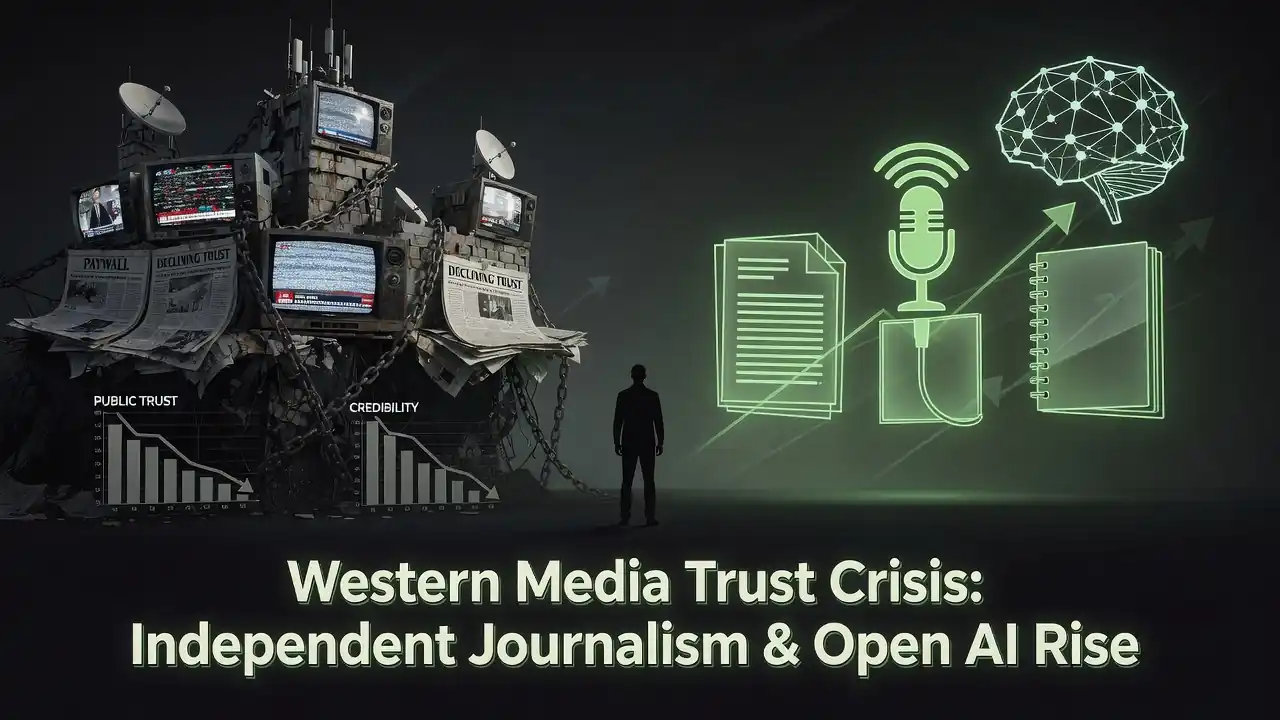
Western Media Trust Crisis: Independent Journalism & Open AI Rise
Related in this series (media-trust): 1. Western Media Trust Crisis (this article) · 2. Statistics Misuse: How Media and Politics Skew Data to Deceive · 3. The Atrocious Intrusive Landscape of Advertising
This analysis focuses exclusively on media ecosystems in Western democracies — the United States and Europe — where corporate and public-funded outlets operate in relatively free but commercially and politically pressured environments. These systems differ markedly from state-controlled or suppressed media in non-Western contexts. Public trust in legacy Western media has eroded sharply. The Reuters Institute’s Digital News Report 2025 shows overall trust stable at 40% globally, but with notable Western divergence: the US sits at just 30%, Germany at 45% (down roughly 15 percentage points since the 2015 peak), and the UK at 35% — a particularly steep 16-point fall since 2015.[1] Concern over distinguishing truth from falsehood online reaches 73% in the US versus around 46% across much of Western Europe.[1] These figures reflect shared structural failures — paywalls, advertising dependency, user-data exploitation, ideological framing, statistical manipulation, fluff, and suppressed feedback — driving audiences toward independents while highlighting the case for minimally restricted AI.
It is worth stating the qualifications plainly. Trust is not collapsing uniformly: Finland (still the highest in the survey at around 67%) and several Nordic markets remain far more trusting than the Anglophone world, and “trust in the news I use myself” runs well above headline trust almost everywhere (57% in Germany, for instance).[1] The crisis is therefore best understood as a crisis of institutional trust — confidence in the press as a category — rather than a wholesale rejection of journalism. That distinction matters, because it is precisely the gap between “I distrust the media” and “I trust this specific writer I pay for” that independent journalism has rushed to fill.
The American picture is the starkest. Pew Research Center’s longitudinal tracking found that just 56% of US adults expressed at least some trust in information from national news organizations in late 2025 — down 11 percentage points in a single year and a 20-point fall since the question debuted in 2016.[13] Crucially, the decline is bipartisan in direction even where it is asymmetric in magnitude: Democratic trust dropped to 69% (its lowest on record) while Republican trust sat at 44%, and both parties now place equal trust (37% each) in social media as an information source.[13] Local news remains the relative bright spot at 70%, a reminder that proximity and accountability — not the act of reporting itself — are what audiences reward.
US vs Europe Data Snapshot
| Country/Region | Trust in News (%) | Change Since 2015 | Fake News Concern (%) |
|---|---|---|---|
| United States | 30 | Stable (low) | 73 |
| Germany | 45 | -15pp | ~46 (Western Europe) |
| United Kingdom | 35 | -16pp | ~46 (Western Europe) |
| Western Europe | 40–50 (avg) | Declining | 46 |
Source: Reuters Institute Digital News Report 2025[1]
Corporate and Public Media's Structural and Editorial Failures Across the West
Revenue pressures dominate both corporate and publicly funded models. In the US, the subscription model leaves the majority of adults outside any paywall — only a minority pay for online news at all, and of those who do, most pay for a single outlet, leaving the rest of the market squeezed for ad revenue.[1] Europe shows parallel stagnation despite public funding for broadcasters. Advertising dependency fuels clickbait on both sides of the Atlantic: the incentive is the click, not the clarification, and the headline is optimised accordingly. User-data exploitation persists via trackers, often with opaque consent flows even in the GDPR-era EU, where “reject all” is frequently buried two clicks deeper than “accept all.”
Publicly or partially government-funded outlets face additional, distinct problems. In Germany, ARD and ZDF operate under compulsory household financing via the Rundfunkbeitrag (broadcasting fee, currently €18.36/month), which every household must pay regardless of whether anyone in it watches or listens.[2] Critics highlight inflated staff and overhead — the combined ARD/ZDF system employs tens of thousands and carries a famously generous pension burden — with bureaucracy mirroring public-sector bloat, fuelling recurring calls for leaner operations.[3] The fee debate has become a constitutional saga: the KEF commission recommended raising the fee to €18.64 from 2027, states declined to enact the earlier increase, ARD and ZDF filed a constitutional complaint, and the Federal Constitutional Court took up the matter in 2026 — all against a backdrop of accusations of political-proximity bias and limited transparency over how the money is spent.[2] Similar tensions appear across Europe’s public broadcasters, from the BBC licence-fee debate in the UK to France’s abolition of the redevance audiovisuelle, where compulsory or state-budget financing weakens direct accountability to the audience it is meant to serve.
It would be unfair to flatten the picture entirely. Public broadcasters still produce a great deal of the West’s most expensive, least commercially viable journalism — long-form investigations, foreign bureaus, regional coverage that no ad-funded startup will replicate. The critique is not that the model produces nothing of value; it is that compulsory financing severs the feedback loop between the audience’s approval and the institution’s survival, so quality and bloat can coexist indefinitely with no market signal to correct either.
Editorial flaws are more consistent. Outlets embed ideological framing — climate, social policy, economics — ahead of raw evidence, and the framing is rarely labelled as such. Reporting often lacks conciseness, padded with opinion presented as context. Statistics are selectively presented (the sibling article in this series, Statistics Misuse, is devoted entirely to that mechanism). And transparency falters at exactly the moments it matters most: corrections are buried deep or appended silently, and audience criticism faces algorithmic demotion or moderated-away comment sections.
Legacy TV's Structural Limitations in Western Media
Traditional broadcast TV exacerbates many of these failures, particularly in public-funded systems. Unlike digital platforms, TV remains largely one-way: viewers cannot provide live feedback, comment in real time, or hold producers accountable during broadcasts. This lack of interactivity contrasts sharply with independent newsletters or podcasts, where audience input is immediate and public. In Germany and across Europe, linear TV channels (many operated by ARD/ZDF) face declining audiences as viewers shift online, yet reforms to close select channels (e.g., ARD alpha, tagesschau24 by end-2026) come slowly.[4] The result is reduced responsiveness and a further disconnect from digital-native audiences.
The Self-Reinforcing Link to Educational Decline in Western Societies
Corporate and public media flaws fuel and are fueled by weakening media literacy. The News Literacy Project’s November 2025 US teen report found 84% hold negative views (“biased,” “boring,” or “bad”), with 45% believing journalists harm democracy and 69% perceiving intentional bias.[5] Reuters 2025 notes similar avoidance trends across Europe, where social media fills gaps left by declining traditional engagement. EU media literacy initiatives exist but remain limited, with educators allocating minimal hours amid competing demands.[6] This cycle reduces demand for critical-thinking education while leaving audiences vulnerable to spin evident in both US partisan divides and European public-broadcaster skepticism.
Independent Journalism's Rapid Ascent and Accountability Model
Independent creators fill the vacuum. Substack surpassed 5 million paid subscriptions by early 2025, with growth accelerating in both US and European markets through direct reader funding over ads.[7] A Change Research poll (December 2025) found 34% of Americans trust independent/online journalists most nearly triple national outlets mirroring rising European reliance on newsletters and podcasts.[8] These models enforce accountability: readers pay for value, feedback is public, bias is transparent and market-tested. Conciseness, source transparency, and responsiveness replace institutional opacity.
What Actually Rebuilds Trust: Three Mechanisms
It is easy to diagnose decline and harder to say what the successful independents actually do differently. Three mechanisms recur across the outlets that have won durable reader loyalty.
1. The feedback loop is reconnected. A reader-funded writer survives only if subscribers keep paying month to month. That single fact reattaches the survival of the publication to the satisfaction of its audience — the loop that compulsory financing severs. When a Substack writer publishes a weak piece, churn rises within the billing cycle; when a public broadcaster does, the Rundfunkbeitrag arrives regardless. The discipline is not virtue, it is plumbing.
2. Bias is disclosed rather than denied. Legacy outlets typically claim a view from nowhere and then smuggle framing in through word choice, story selection, and which experts get quoted. Independents tend to wear their priors openly — and a declared slant is far easier for a reader to discount than a denied one. Transparency about standpoint, paradoxically, reads as more honest than the institutional pose of neutrality that audiences have learned to distrust.
3. Corrections are visible and fast. The most trusted independents timestamp edits, publish errata above the fold, and engage critics in the comments rather than moderating them away. Compare this to the legacy habit of silent edits and buried corrections, which News Literacy Project surveys identify as a top driver of the “intentional bias” perception among younger readers.[5]
These mechanisms also explain the Pew finding that local news outperforms national: locality forces the same accountability that reader-funding manufactures. A regional editor meets the audience at the grocery store; a national anchor does not.[13]
A Necessary Counterpoint: Where Independents Fail
Honesty requires stating the failure modes too. Reader-funded journalism is not a panacea, and pretending otherwise would repeat the very credulity this series criticises.
The most obvious risk is the echo-chamber incentive. A writer paid directly by an audience has a financial reason to tell that audience what it wants to hear; the same feedback loop that rewards responsiveness can reward flattery. Subscription models can therefore manufacture narrower worlds, not broader ones — the opposite of the shared-fact baseline a democracy needs.
Second, independents rarely fund the expensive, unglamorous work: foreign bureaus, multi-year investigations, courtroom and statehouse coverage that produces no viral moment. Much of that load still falls to the very legacy and public institutions under critique here, which is why “abolish the broadcasters” is a worse answer than “reform their accountability.”
Third, the space is vulnerable to capture and grift. The low barrier to entry that lets a great reporter go independent also lets a confident fabulist build an audience with zero editorial check. Without the institutional friction of an editor and a corrections desk, a charismatic individual can spread a polished falsehood faster than any newsroom. The model rewards trust-building but does not by itself reward trustworthiness — readers must still supply the scrutiny.
The honest conclusion is not “independents good, institutions bad,” but that the accountability architecture matters more than the label. Whatever reconnects output to audience approval — reader funding, locality, transparent corrections — tends to rebuild trust; whatever severs it tends to erode trust.
AI Development with Minimal Guardrails: The Essential Counterbalance
Fragmented Western information ecosystems demand AI prioritizing evidence over curated safety. Heavy guardrails in leading models risk echoing legacy media biases. Minimally restricted development pairs naturally with independent journalism.
Recent 2025–2026 studies compare:
-
ChatGPT (OpenAI) and Claude (Anthropic) use extensive filters, showing consistent left-leaning tendencies on social/economic issues per IEEE Access 2025 and Anthropic’s November 2025 research.[9][10] Refusals limit analysis.
-
Gemini (Google) adopts centrist framing but retains corporate-aligned guardrails, with high refusal rates per Brookings (October 2025).[11]
-
Grok (xAI) employs lighter restrictions. Evaluations rank it among the lowest in detectable bias and highest in responsiveness, with minimal refusals.[12] It surfaces evidence-based views without ideological defaults.
Minimal guardrails block illegal content but avoid external shaping distorting Western media narratives. In an era of filtered reporting, such AI delivers unvarnished data across US and European perspectives.
Key Takeaways
- Western media trust is critically low: US 30%, Germany 45% (-15pp), UK 35% (-16pp) per Reuters 2025, driven by paywalls, data exploitation, compulsory fees, staff bloat, and opacity.
- Public broadcasters add unique issues: Germany’s ARD/ZDF compulsory Rundfunkbeitrag and large staffing levels fuel inefficiency and bias debates.
- Legacy TV’s one-way nature limits live feedback, widening the gap with digital independents.
- These failures correlate with teen media illiteracy (84% negative US views) and parallel European trends.
- Independent journalism leads trust via direct accountability; minimally restricted AI like Grok supports unbiased inquiry.
- Transparent, feedback-driven systems in journalism and AI are essential for Western democratic discourse.
Conclusion
Western corporate and public media’s monetization-over-mission and forced-financing models have accelerated decline on both sides of the Atlantic, degrading critical thinking in education. Independent journalism provides a reader-funded corrective, while minimally guarded AI offers technological reinforcement. Prioritizing evidence, transparency, and minimal external influence is foundational for informed citizenship in 2026 and beyond.
Sources
- Reuters Institute (2025). Digital News Report 2025.
- IAmExpat (2026). German TV "tax" likely to increase from 2027.
- Xpert.digital (2026). Why public broadcasting is in an unprecedented crisis of confidence.
- Broadband TV News (2026). ARD and ZDF to close linear TV channels under reform treaty.
- News Literacy Project (2025). "Biased, Boring and Bad: Unpacking Perceptions of News Media Among U.S. Teens."
- European Commission (2026). Media Literacy.
- Change Research (2025). "Americans Turn to Independent Voices."
- Change Research (2025). "Americans Turn to Independent Voices" (Trust Poll Data).
- IEEE Access (2025). "Political Bias in Large Language Models: Comparative Analysis."
- Anthropic (2025). Political Even-Handedness Research (Nov 2025).
- Brookings Institution (2025). "Is the Politicization of Generative AI Inevitable?"
- AIonX (2025). AI Chatbot Bias Comparison Study.
- Pew Research Center (2025). How Americans' trust in information from news organizations and social media sites has changed over time. — US national trust 56% (-11pp in a year), local 70%, partisan breakdown.


Comments
Comments are powered by Giscus (GitHub Discussions).
Enable functional cookies to load comments.