

Introduction
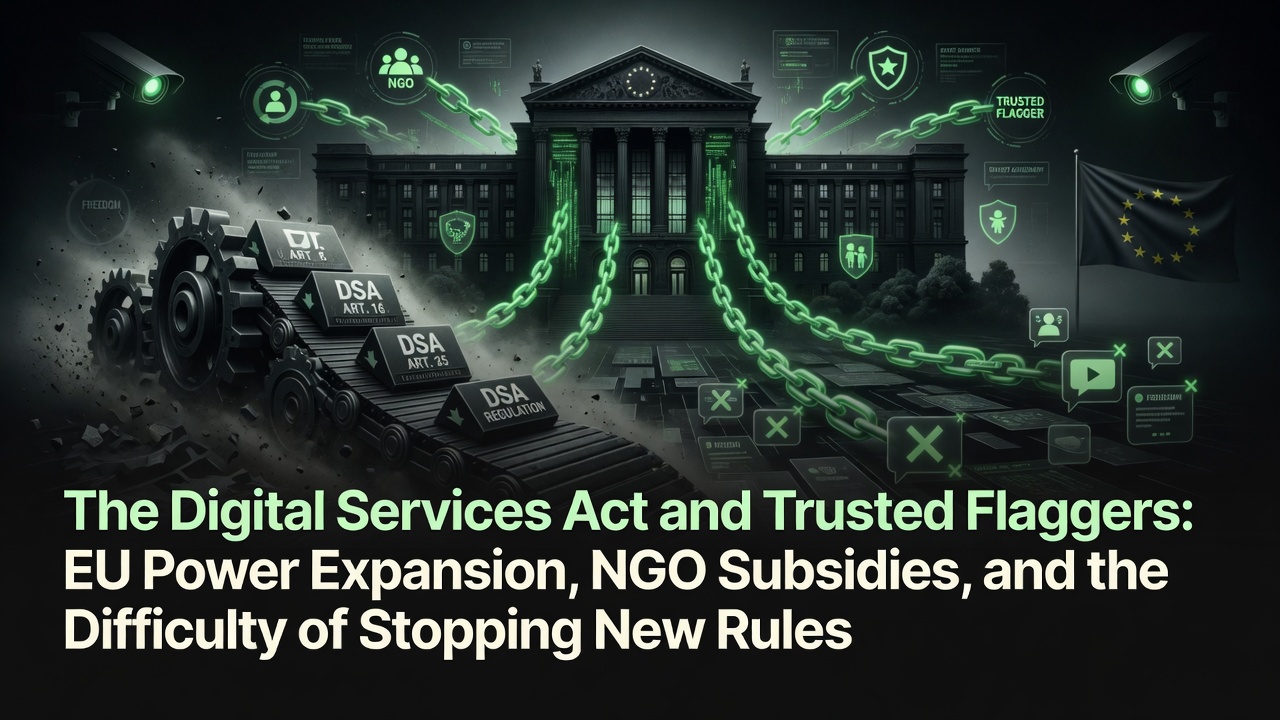
The European Union’s Digital Services Act (DSA) establishes the Trusted Flaggers system to speed up action against illegal online content.[1] While framed around user safety, the mechanism forms part of a recurring pattern in EU digital regulation: the creation of layered administrative powers, frequent involvement of publicly supported civil society organizations, and legislative dynamics that make it structurally difficult to halt or substantially redirect rules once they gain institutional momentum.
This article explores these dimensions through the lens of Trusted Flaggers, drawing on the framework’s design and implementation experience.
What Are Trusted Flaggers Under the DSA?
Under Article 22 of the DSA (Regulation (EU) 2022/2065), Trusted Flaggers are entities (not individuals) granted special status by a Member State’s Digital Services Coordinator (DSC).[2] Once designated, online platforms must give their notices on illegal content priority treatment and process them without undue delay.[3]
To receive status, an entity must show:[1]
- Specific expertise and competence in detecting, identifying, and notifying illegal content.
- Independence from any online platform providers.
- Operation in a diligent, accurate, and objective manner.
The designation applies across the EU.[1] Platforms can trigger reviews if a flagger submits a significant number of insufficiently precise or inaccurate notices, potentially leading to suspension or revocation by the DSC after an investigation.[3] Trusted Flaggers must publish annual public reports on their activities, and the European Commission maintains an updated public database of all designated entities.[1]
EU Power Expansion Through Regulation
The DSA and related instruments significantly expand the EU’s regulatory and enforcement footprint in the digital space. Very Large Online Platforms must conduct systemic risk assessments covering not only illegal content but also broader issues such as disinformation, manipulation of electoral processes, and negative effects on civic discourse.[2],[4] Non-compliance can result in fines reaching up to 6% of global annual turnover, enforced primarily by the European Commission for the largest platforms.[4]
Trusted Flaggers add another layer: DSCs hold the power to designate entities that then receive mandatory priority treatment from platforms operating EU-wide.[1] This creates a chain of authority running from national coordinators through designated organizations to private platforms, backed by substantial financial penalties. Critics argue that such structures concentrate influence in administrative bodies with relatively few immediate checks from elected institutions or affected users once the rules are in force.[7]
Subsidizing NGOs as Enforcers and Policy Actors
Many organizations active in content flagging or related policy areas receive funding through EU programmes. The network of national Safer Internet Centres — which typically combine an awareness centre, a helpline, and an INHOPE-member hotline focused on child sexual abuse material — is co-funded by the European Commission under the Digital Europe Programme, within the Better Internet for Kids (BIK+) strategy.[5],[6]
This funding dynamic raises questions about independence and feedback loops. Organizations that receive public grants for child protection or hate speech work can later apply for Trusted Flagger status, gaining prioritized access to platform moderation systems. Academic analysis of Article 22 has flagged funding sources and independence verification as open questions in the designation process — independence from platform providers is a criterion DSCs must verify, and questions about who finances a flagger feed directly into that assessment.[7] Civil society groups themselves have raised concerns about designation standards, including how independence should be determined and whether law enforcement bodies or profit-seeking industry organizations should be eligible at all.[8],[9]
Critics see this as a self-reinforcing cycle in which publicly resourced actors help shape and then enforce regulatory priorities. While official criteria emphasize independence and objectivity, the practical reliance on EU funding sources for operational capacity can align incentives with broader institutional goals.
How New Rules Advance With Limited Effective Opposition
Most major EU digital regulations, including the DSA, follow the ordinary legislative procedure. The European Commission initiates proposals. The European Parliament and Council then negotiate positions, frequently through informal trilogue meetings involving representatives of all three institutions to reach compromises quickly — the route by which the large majority of EU legislative files are now agreed.[10]
Council decisions generally require a qualified majority: at least 55% of Member States (15 of 27) representing at least 65% of the EU population, with a blocking minority needing at least four Member States.[11] Once political agreement is reached in trilogue and formally endorsed, the process moves toward adoption with limited remaining opportunities for fundamental reversal.
In practice, this structure means that once a proposal gains significant institutional backing and moves past early stages, sustained opposition from individual Member States, civil society, or platforms faces high procedural hurdles. Trilogue negotiations are often conducted with limited public transparency — a long-standing criticism raised by digital rights groups and examined by the European Ombudsman, whose 2016 strategic inquiry pushed the institutions toward publishing more trilogue documents.[10],[12] The combination of high compliance costs for platforms and coordinated enforcement across the single market further entrenches rules after adoption. Changing course later typically requires entirely new legislative proposals subject to the same dynamics.
The DSA itself illustrates the timeline: proposed by the Commission in December 2020, politically agreed in trilogue in April 2022, formally adopted in October 2022, and fully applicable from 17 February 2024.[13] A typical path for a regulation like this looks as follows:
- Commission publishes proposal.
- Parliament and Council conduct first readings and develop positions.
- Informal trilogue negotiations seek compromise.
- Political agreement reached.
- Formal adoption by Parliament and Council.
- Publication in the Official Journal.
- Phased entry into application (with transitional periods).
Once past the trilogue stage, reversing or substantially diluting core elements becomes rare.
Official Safeguards and Counter-Perspectives
Proponents and official sources emphasize several built-in protections within the Trusted Flaggers framework. Entities must publish detailed annual reports covering the number and types of notices submitted and the actions taken by platforms.[1] The Commission maintains a public, machine-readable database of all awarded statuses.[1] DSCs can investigate and suspend or revoke status if a flagger submits a significant number of insufficiently precise or inaccurate notices, following information from platforms or on their own initiative.[3] Platforms retain final responsibility for deciding whether content is illegal and must provide statements of reasons to users.[2]
In May 2026, the Commission published draft guidelines under Article 22(8) aimed at clarifying eligibility, strengthening safeguards, and supporting consistent application, with a targeted consultation running to July 2026 and adoption planned for the second half of the year.[14] Supporters argue that the system targets only illegal content (as defined by law), improves efficiency over ordinary user notices, and includes revocation mechanisms that earlier voluntary flagging arrangements lacked. They stress that these features, combined with transparency requirements, provide meaningful accountability while advancing legitimate safety objectives.
Child Safety Narratives and Broader Control
Child protection, especially against child sexual abuse material, serves as one of the strongest and most widely accepted justifications for enhanced flagging mechanisms. Hotlines and networks focused on this issue have long-standing operations that align closely with DSA goals.[5]
At the same time, the child safety imperative sits within a wider DSA architecture that addresses systemic risks on large platforms, including disinformation and other “harmful” content categories.[4] Some observers argue that the moral weight of protecting children provides political cover for expanding regulatory infrastructure and designation powers into more contested domains of speech and information. The prioritized notice channel can accelerate outcomes across a broader range of content once the system is operational.
Surveillance Structures and Historical Parallels
Critics have drawn parallels between the Trusted Flaggers ecosystem and historical models of monitored public discourse. The structure involves state-coordinated designation of reporting entities, mandatory platform responses to prioritized notices, and broader platform obligations to monitor systemic risks. This creates layered observation and enforcement channels with administrative rather than purely judicial gatekeeping in many instances — a tension academic commentary has examined specifically in relation to internet users’ freedom of expression.[7]
When combined with the involvement of publicly funded organizations and the structural difficulty of unwinding the underlying rules, some commentators see echoes of systems that relied on networks of approved reporters and indirect control over expression. Supporters reject these analogies, pointing to the narrow focus on illegal content, transparency obligations, and revocation procedures as key distinctions.
Key Takeaways
- The DSA Trusted Flaggers system creates prioritized notice channels backed by significant enforcement powers for non-compliant platforms.
- EU digital regulation frequently expands administrative designation and oversight authority while relying on networks that include publicly funded civil society actors.
- Funding relationships between EU programmes and NGOs/hotlines active in content areas can create practical dependencies and incentive alignments.
- The ordinary legislative procedure, with its reliance on trilogues and qualified majority voting, makes it procedurally difficult to halt or fundamentally redirect major regulatory packages once they advance past early negotiation stages.
- Official safeguards such as annual reporting, public databases, and revocation mechanisms exist, yet critics maintain that the overall architecture still concentrates influence in ways that are hard to reverse.
- Child safety provides a compelling core rationale, but the surrounding systemic risk framework allows the mechanism to influence wider areas of content governance.
Conclusion
The Trusted Flaggers framework under the Digital Services Act reflects recurring features of EU digital policy: the layering of regulatory power through designation mechanisms, the integration of publicly supported organizations into enforcement roles, and legislative processes that favor forward momentum over easy reversal. While child protection and the removal of clearly illegal content remain important objectives with broad support, the structural design and implementation incentives continue to generate debate about accountability, scope creep, and the balance between safety and open expression.
Implementation so far has been slower and more uneven than the framework’s ambitions suggested — designations trickled in during the first year of full application, prompting observers to ask where all the Trusted Flaggers were.[15] As more entities receive status and enforcement actions accumulate, the practical consequences of these design choices will become clearer. The pattern of creating durable regulatory architectures with limited off-ramps suggests that early scrutiny of new proposals remains one of the more effective points of influence.
Sources
- European Commission — Trusted flaggers under the Digital Services Act (DSA). Official policy page: designation criteria, EU-wide validity, annual reports, and the public database of designated entities.
- Regulation (EU) 2022/2065 (Digital Services Act) — full text, EUR-Lex. Article 22 (trusted flaggers), Article 17 (statements of reasons), Articles 34–35 (systemic risk assessment and mitigation).
- Article 22, the Digital Services Act — annotated provision text. Priority treatment of notices, reporting obligations, and the suspension/revocation mechanism for imprecise notices.
- European Commission — The enforcement framework under the Digital Services Act. Commission enforcement powers over VLOPs/VLOSEs and fines of up to 6% of global annual turnover.
- European Commission — Safer Internet Centres. National centres (awareness centre, helpline, INHOPE-member hotline) co-funded under the Digital Europe Programme.
- European Commission — A European strategy for a better internet for kids (BIK+).
- Jacob van de Kerkhof (2025). "Article 22 Digital Services Act: Building trust with trusted flaggers?" Internet Policy Review 14(1). Academic examination of independence, funding, transparency, and freedom-of-expression concerns. DOI: 10.14763/2025.1.1828.
- Center for Democracy & Technology (2023). Trusted Flaggers in the DSA: Challenges and Opportunities.
- EDRi (2023). How to protect fundamental rights when appointing Trusted Flaggers (guide for Digital Services Coordinators, PDF).
- European Parliamentary Research Service (2021). Understanding trilogue — informal tripartite meetings to reach provisional agreement on legislative files (PDF). Includes the European Ombudsman's strategic inquiry into trilogue transparency.
- Council of the European Union — Qualified majority voting. 55% of Member States (15 of 27) representing at least 65% of the EU population; blocking minority requires at least four Member States.
- EDRi — Trilogues: the system that undermines EU democracy and transparency.
- Council of the European Union — Digital Services Act (policy page and legislative timeline).
- European Commission (2026). Draft Commission guidelines on trusted flaggers (Article 22(8) DSA). Published 29 May 2026; targeted consultation open until 10 July 2026.
- TechPolicy.Press — Europe's Digital Services Act: Where Are All The Trusted Flaggers? On the slow pace of designations during early implementation.

Comments
Comments are powered by Giscus (GitHub Discussions).
Enable functional cookies to load comments.