

Introduction
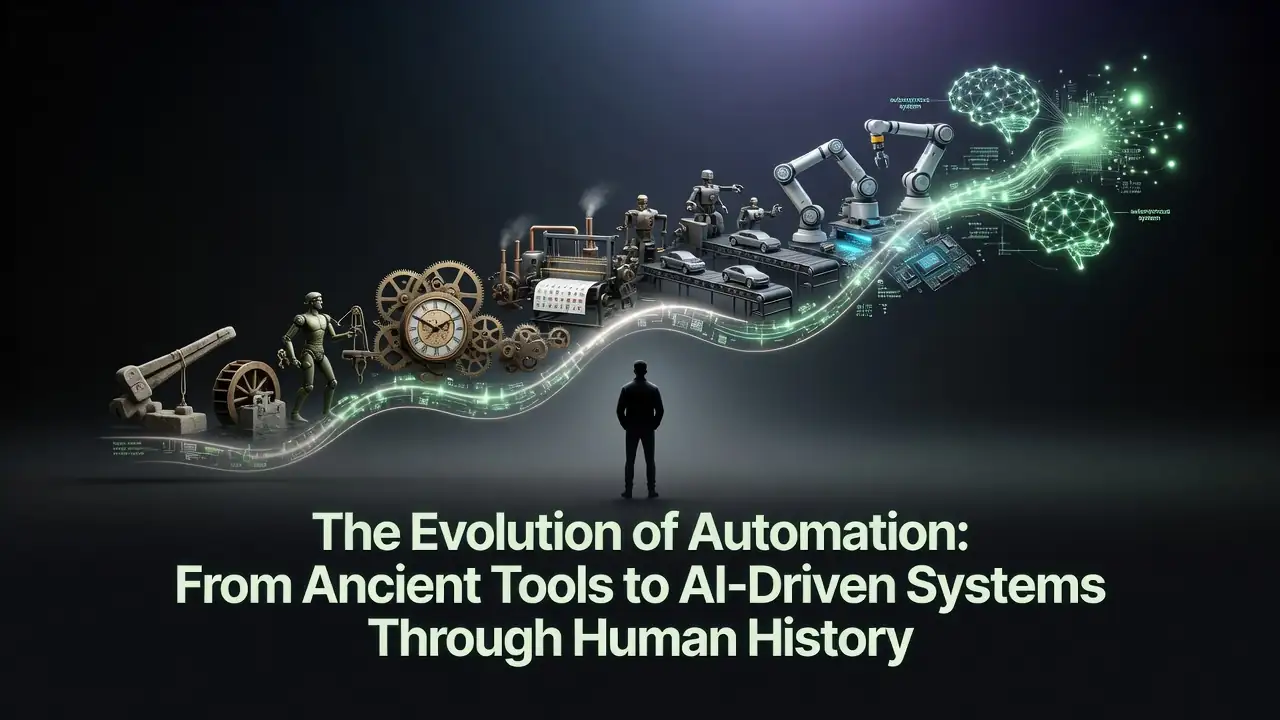
The concept of automation has shaped human progress for millennia. It represents humanity’s enduring drive to reduce manual labor, increase efficiency, and extend capabilities through machines that operate with minimal or no human intervention. From prehistoric levers and water wheels to today’s AI systems that make decisions and learn autonomously, automation has evolved in parallel with technology, society, and economic needs. This journey reflects not only technological innovation but also shifts in how humans view work, creativity, and control.
A useful way to read the timeline below is as a slow migration along two axes at once: from augmenting muscle (lifting, grinding, pumping) toward augmenting mind (deciding, planning, learning), and from fixed behavior baked permanently into hardware toward flexible behavior that can be reprogrammed — and, most recently, that reprograms itself. Almost every milestone in this article can be located somewhere on those two axes, and the overall direction of travel never reverses.
It helps to define the term before tracing it. Encyclopaedia Britannica describes automation as “the application of machines to tasks once performed by human beings or, increasingly, to tasks that would otherwise be impossible,”[2] and classifies industrial automation into three families: fixed (or “hard”) automation, where the operation sequence is locked into the equipment; programmable automation, suited to batch production; and flexible automation, which can switch products with little downtime.[2] That three-way split is a useful lens for the whole timeline below: each era of history pushed automation a little further along the path from fixed to flexible, and finally toward systems that reprogram themselves.
Ancient Origins: Simple Machines and Automata
Automation’s roots trace back over 5,000 years. Around the 4th millennium BCE, Mesopotamians developed the wheel and axle, enabling carts and pottery wheels that reduced manual effort.[1] Ancient civilizations created early powered mechanisms: Chinese trip-hammers driven by water automated grain processing and forging.[2] Water wheels and windmills performed repetitive tasks such as irrigation and milling without constant human input. Even imperial Rome practiced a primitive form of feedback control — Britannica notes that the regulation of liquid level using a float was practiced in antiquity and that such float-valve mechanisms are the conceptual ancestors of modern feedback control,[2] a self-regulating loop identical in principle to the float in a modern toilet cistern. These were not “smart” machines in any modern sense, but they crossed a crucial line: a device that adjusts its own behavior in response to its environment, without a human in the loop, is doing the essential thing automation does.
Philosophers and inventors imagined more advanced forms. Greek myths described Hephaestus forging metal automata as servants — the bronze giant Talos, who patrolled the shores of Crete three times a day, and the golden handmaidens of his workshop — making antiquity’s storytellers, not just its engineers, the first to dream of artificial labor.[5] By the 3rd century BCE, Hellenistic engineers such as Ctesibius of Alexandria built water-powered organs and pneumatic devices that demonstrated programmable mechanical action. In ancient Egypt, Greece, and Rome, engineers built mechanical statues and temple devices that moved autonomously through hidden siphons, weights, and steam, serving religious, entertainment, or practical purposes.[5] Hero of Alexandria, writing in the 1st century CE, catalogued automatic temple doors, coin-operated dispensers (a holy-water vending machine), self-trimming lamps, and even programmable theatres in his treatise On Automata.[5] These early automata embodied the concept of machines acting of their own will — and established a pattern that recurs throughout this history: the idea of automation almost always precedes the practical means to build it. The Greeks could imagine Talos millennia before anyone could build a machine that walked, and even Hero’s working automata were powered theatre, not productive labor. The gap between dream and deployment would narrow steadily, but it never fully closes — it simply moves to the next frontier.
Medieval and Renaissance Advances
The Middle Ages and Islamic Golden Age advanced mechanical ingenuity. Windmills with automatic sail-turning mechanisms spread across Europe and the Middle East. The mechanical clock, developed in the 14th century in Europe, used weights, gears, and the escapement for self-regulating timekeeping[1] — arguably the first widely deployed machine whose entire purpose was to run on its own, unattended, for days at a time. In Baghdad’s House of Wisdom around 850 CE, the three Banū Mūsā brothers compiled the Book of Ingenious Devices (Kitāb al-Ḥiyal), describing roughly one hundred mechanisms — trick vessels, fountains, and an automatic flute player often called the first programmable machine — many using automatic valves and rudimentary feedback control powered by water and weights.[9] Three centuries later, the engineer al-Jazarī extended this tradition with elaborate water clocks and humanoid automata.
During the Renaissance, Leonardo da Vinci sketched designs for self-propelled carts and a mechanical knight around 1495, apparently assembled and displayed for the first time at the Milanese court of Ludovico Sforza; operated by a system of pulleys and cables, the armored automaton could sit, stand, raise its visor, and move its arms — two independent linkage systems gave it three degrees of freedom in the legs and four in the arms.[10] The design was reconstructed in working form only after Leonardo’s sketches resurfaced in the 1950s. Leonardo’s spring-driven self-propelled cart — sometimes called the first “robot car” — even followed a pre-set steering program set by pegs, making it a mechanical ancestor of the programmable machine. These conceptual automata pushed the boundary between tool and independent machine, laying groundwork for programmable systems centuries before the engineering existed to make them reliable.
The Industrial Revolution: Mechanization Takes Hold
The late 18th and early 19th centuries marked a pivotal shift. James Watt’s improved steam engine, patented in 1769, powered factories and enabled mechanized production at a scale water wheels never could.[2] Watt’s later addition of the centrifugal flyball governor — which automatically throttled steam to hold engine speed steady as load changed — is often cited as the first widely industrialized feedback-control device, a direct descendant of those ancient float valves and a direct ancestor of every thermostat and cruise control since.
The Jacquard loom, demonstrated around 1801 by Joseph-Marie Jacquard in Lyon, used a chain of punched cards to program complex woven patterns, with the holes determining which warp threads lifted on each pass of the shuttle.[3] This was a conceptual leap as important as any engine: it separated the machine from the instructions, so that changing the cards changed the product without rebuilding the loom. Charles Babbage borrowed exactly this punched-card idea for the input of his proposed Analytical Engine, and Herman Hollerith later used punched cards to tabulate the U.S. census — a lineage that runs straight from a silk loom to the early data-processing industry.[3]
Oliver Evans built a highly automated flour mill in the 1780s in which bucket elevators and conveyors moved grain through the entire process with little manual handling, an early example of continuous, integrated production.[1] Together these developments replaced human and animal power with mechanical force on a massive scale, birthing the factory system and transforming economies — and, for the first time, provoking organized anxiety about machines displacing workers (the Luddite protests of 1811–1816 were a reaction to precisely this kind of textile automation).
Early 20th Century: Assembly Lines and the Birth of Modern Automation
Henry Ford’s moving assembly line, run for the first time across the whole Highland Park plant on 7 October 1913, revolutionized manufacturing. By bringing the work to stationary workers rather than moving workers to the work, it cut the time to assemble a Model T chassis from roughly 12.5 hours to about 93 minutes within a year.[3][4] The productivity gain let Ford slash the car’s price and pay the famous $5 day — a vivid early illustration of a pattern that recurs throughout automation’s history: mechanization can raise wages and lower prices even as it deskills and intensifies individual jobs. Note, too, what the assembly line was not: it was not autonomous. It was fixed automation in the purest sense — the sequence was locked into the physical layout of the line, and any change of product meant retooling the whole plant.
Electrification and interchangeable-parts standardization further scaled output, and World War II accelerated innovation with automated production of military equipment. The word “automation” itself was popularized around 1946–1947 by Ford’s Delmar S. Harder, who used it for the company’s new “Automation Department” charged with mechanizing the handling of parts between machines.[2] Tellingly, the term was coined to describe moving things automatically, not thinking automatically — the cognitive frontier was still decades away.
Mid-20th Century: Computers, Robots, and the Term Automation
The 1950s and 1960s integrated electronics and computing. George Devol filed his patent for a “Programmed Article Transfer” in 1954 (granted 1961); with Joseph Engelberger he founded Unimation, and their Unimate became the first industrial robot when one was installed on a General Motors die-casting line in New Jersey in 1961.[6][7] The 4,000-pound arm obeyed pre-programmed commands stored on a magnetic drum to lift and quench hot die-castings and spot-weld bodies — dangerous work that had poisoned and maimed human operators.[7] Crucially, Unimate was programmable automation, not fixed: you could teach it a new motion sequence without rebuilding the machine, which is exactly what made the robot, rather than the conveyor, the seed of a new industry.
In parallel, the electronic computer arrived: ENIAC (1946) realized in vacuum tubes the kind of general-purpose computation Charles Babbage had only been able to design on paper a century earlier.[2] Programmable logic controllers (PLCs), introduced in the late 1960s to replace banks of hard-wired relays, gave factory floors reliable, reprogrammable control. The Stanford Arm (1969) introduced an all-electric, computer-controlled robotic arm with the kinematics and feedback that made precise, sensor-guided manipulation practical.[6] Together these threads — the programmable robot, the general-purpose computer, and reprogrammable factory control — converged into what we now simply call “automation.”
The Digital Age and Rise of Robotics
From the 1970s onward, microprocessors and integrated circuits miniaturized and accelerated automation.[8] Europe entered the field decisively in 1973–1974: Germany’s KUKA built FAMULUS, among the first articulated robots with six electromechanically driven axes (a configuration that remains the most common industrial-robot kinematic today), and Sweden’s ASEA — later part of ABB — shipped the IRB 6, the world’s first commercially available all-electric, microprocessor-controlled industrial robot.[11] Industrial robots from ABB, KUKA, and FANUC went on to spread globally.[7]
The 1980s and 1990s brought computer numerical control (CNC) machines, machine-vision systems, and force/torque sensors, giving machines a crude sense of sight and touch and closing the perception–action loop that earlier robots lacked. Robotic process automation (RPA) later extended the same idea to pure software — scripting the keystrokes and form-filling of back-office data entry — so that “automation” no longer required any moving parts at all. Automation moved well beyond the factory into logistics, agriculture, finance, and consumer services.
The AI Era: Intelligent Automation Today
The 21st century fused automation with artificial intelligence, and in doing so crossed the long-anticipated line from augmenting muscle to augmenting mind. Where classical automation executed a fixed or pre-programmed sequence, machine-learning systems infer their own rules from data — they adapt, predict, and optimize without an engineer specifying every step in advance. This is the closest the timeline has yet come to the self-reprogramming machine that the fixed → programmable → flexible progression always pointed toward.
The practical consequences arrived quickly. Collaborative robots (cobots) trade raw speed for force-limited safety so they can share a workspace with people instead of being caged off from them. AI-driven platforms now automate genuinely cognitive work: triaging support tickets, screening medical images, routing freight, detecting fraud, drafting and summarizing text, and generating images and code. As of 2026, the stack spans edge inference on the factory floor, large models in the cloud, and increasingly autonomous agents that chain tasks together with minimal supervision. The focus has shifted from mere mechanization to systems that improve with use — but the shift also reopens older questions in sharper form: when a system learns its behavior rather than having it specified, accountability, bias, and explainability become engineering problems, not just philosophical ones.
The Recurring Pattern: Labor, Fear, and Adaptation
Read end to end, the history of automation is less a straight line of gadgets than a repeating cycle. A new technology automates a category of work; the workers in that category fear (often correctly) for their immediate livelihoods; the economy absorbs the change over a generation, usually creating new categories of work that did not previously exist; and the cycle resets one rung higher on the ladder from muscle toward mind.
- Antiquity to the loom: the idea of artificial labor (Talos, Hero’s theatres) long preceded any machine that could actually displace a worker. Fear was philosophical, not economic.
- The Industrial Revolution: for the first time, automation displaced workers at scale and provoked organized resistance — the Luddites smashing textile frames in 1811–1816. Yet textile employment ultimately grew as cheaper cloth expanded demand.
- The assembly line: Ford’s line destroyed the craft of the skilled coachbuilder but created millions of higher-paid (if more monotonous) factory jobs, and put cars within reach of the people who built them.[4]
- The computer and the robot: automation began consuming routine cognitive and manipulative work, hollowing out some middle-skill jobs while creating entire industries — software, robotics integration, logistics — that employ far more people than the robots replaced.
- The AI era: for the first time, automation targets non-routine cognitive work that was long assumed to be safely human. Whether the historical pattern of net job creation holds for work that automates judgment itself is the open question of our decade.
The lesson is not that “automation always creates more jobs than it destroys” — that is too glib, and the gains and losses rarely land on the same people. The durable lesson is about transition: the technology arrives faster than institutions, skills, and safety nets adapt, and the human cost is concentrated in that lag. Every era in this article that handled automation well did so by investing in the adaptation, not by stopping the machine.
Key Takeaways
- Automation began with prehistoric simple machines and ancient automata designed to reduce labor and perform repetitive tasks.
- The Industrial Revolution transformed the concept through steam power, programmable looms, and factories, replacing human muscle with mechanical force.
- 20th-century milestones including assembly lines, computers, and the first industrial robots formalized modern automation and coined the term itself.
- Digital and AI eras have made automation adaptive, intelligent, and ubiquitous, extending far beyond physical manufacturing.
- Each leap moved automation along two axes at once — from augmenting muscle toward augmenting mind, and from fixed behavior toward reprogrammable and now self-learning behavior.
- Throughout history, automation has driven productivity gains while raising recurring questions about labor displacement and human purpose — and the human cost has consistently concentrated in the transition lag, not the technology itself.
Conclusion
The concept of automation has evolved from humanity’s earliest efforts to augment physical strength with tools to today’s sophisticated AI systems that replicate and exceed cognitive functions. Each era built upon the last, driven by the same core impulse: to achieve more with less direct human effort. As automation continues to advance, it challenges societies to balance efficiency with equity, creativity with control, and technological progress with human values. Understanding this long arc equips us to navigate the next phase responsibly.
Sources
- Computer History Museum — "1801: Punched cards control Jacquard loom" (and the museum's broader timeline on early mechanization and information storage). Accessed 2026.
- Encyclopaedia Britannica — "Automation | Technology, Types, Rise, History, & Examples", including the entries on fixed, programmable, and flexible automation. Accessed 2026.
- Encyclopaedia Britannica — "Jacquard loom" and "Joseph-Marie Jacquard" (punched cards, programmability, and the link to Babbage and Hollerith). Accessed 2026.
- Library of Congress — "Ford Implements the Moving Assembly Line", and HISTORY — "Moving assembly line debuts at Ford factory (October 7, 1913)". Accessed 2026.
- Smithsonian Magazine — "Was Talos, the Bronze Automaton Who Guarded the Island of Crete in Greek Myth, an Early Example of Artificial Intelligence?" (on Hephaestus's automata, Talos, and Hero of Alexandria). Accessed 2026.
- IEEE Spectrum — "In 1961, the First Robot Arm Punched In" (Unimate, Devol, Engelberger, and the Stanford Arm lineage). Accessed 2026.
- The Henry Ford — "First Unimate Robot Ever Installed on an Assembly Line, 1961", with industry context from A3/Automate, "Unimate — The First Industrial Robot". Accessed 2026.
- Encyclopaedia Britannica — "Automation — Manufacturing applications of automation and robotics" (microprocessors, CNC, vision, and the spread beyond the factory). Accessed 2026.
- Wikipedia — "Book of Ingenious Devices" (the Banū Mūsā brothers, ~850 CE, and the automatic flute player as an early programmable machine). Accessed 2026.
- Wikipedia — "Leonardo's robot" (the ~1495 mechanical knight, its pulley-and-cable linkages, and the 1950s rediscovery and reconstruction). Accessed 2026.
- AllAboutLean — "KUKA FAMULUS Turns 50 — The First Modern Industrial Robot" (KUKA FAMULUS, 1973, and the ABB/ASEA IRB 6, the first all-electric microprocessor-controlled robot). Accessed 2026.

Comments
Comments are powered by Giscus (GitHub Discussions).
Enable functional cookies to load comments.